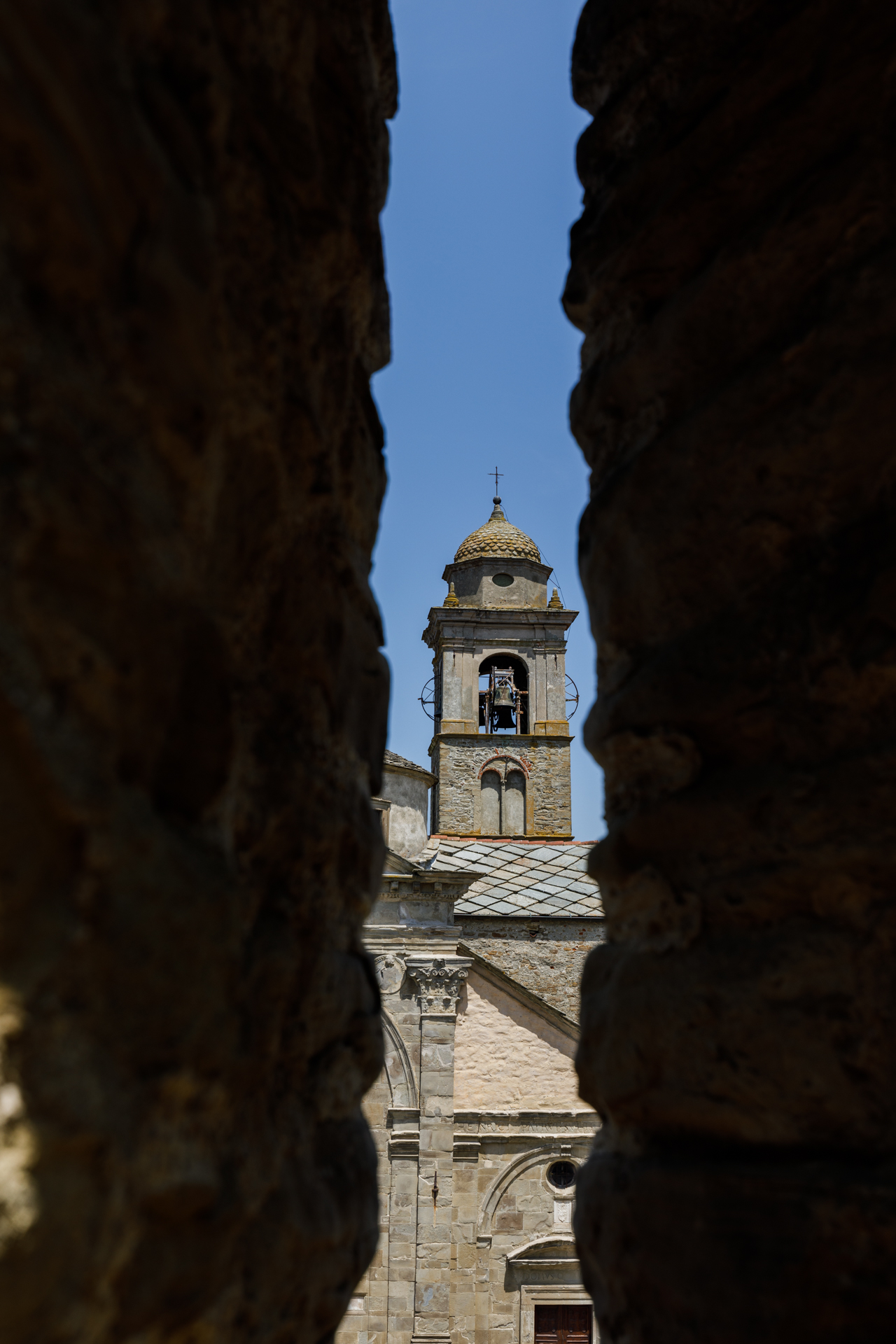
In Roccaverano, the landscape slowly opens up. The hills become more barren, the wind shifts direction, the stone takes on a light. The Church of San Giovanni Battista has stood there for centuries, essential and present.
The Church of San Giovanni Battista doesn't dominate the area. It accompanies it.
It's a restrained presence, built with the same material as the surrounding hills. Pale stone. Simple geometry. A Romanesque façade that seeks balance rather than monumentality.
Arriving here means entering a part of the Bormida Valley where the landscape truly slows down. The roads climb slowly through pastures, hazelnut groves, and small villages. The air changes. Even the noise changes.

Around the church, silence isn't absence. It's space.
A space to observe the soft lines of the Alta Langa, the profile of the towers, and the light moving across the stones during the day.
For those who work remotely or choose extended stays, Roccaverano represents a concrete form of balance.
Not a refuge cut off from the world, but a place where time becomes legible again. A respite among calls, trails, and simple tables. A territory that allows concentration without pressure.
Inside, traces of an ancient devotion remain, but it's the exterior that truly leaves a lasting impression. The location, the afternoon light, the sense of spaciousness that opens up around the churchyard.
On clear days the gaze stretches far away.
Towards other hills. Other villages. Other rhythms.
Roccaverano belongs to that part of the Bormida Valley that doesn't amass attractions. It preserves a presence.
And that's exactly what makes it memorable.